
NHASA

Categories
Blogs

Halal Certification Benefits for Non-Halal Businesses

Halal certification is often associated exclusively with Muslim consumers and religious compliance, but its significance extends well beyond faith-based markets. Today, many non-Halal businesses pursue certification to strengthen market access, improve transparency, and align with recognized compliance frameworks. Certification provides a structured system covering ingredient sourcing, manufacturing, hygiene, and supply chain management. Businesses adopting these standards benefit from improved credibility, operational efficiency, and access to global markets. Understanding these advantages is critical for informed decision-making.

Why Some Non-Muslims Choose Halal?

Many non-Muslim consumers choose Halal-certified products because the certification process emphasizes hygiene, traceability, and responsible sourcing. Halal standards require detailed documentation of ingredients, contamination control, and ethical production practices, ensuring product integrity. Consumers also value the structured oversight provided by Halal certification authorities. The verification process reassures buyers that products meet high safety, quality, and ethical standards, regardless of religious considerations.

Understanding the Principles Behind Halal Certification

1. Permissible Ingredients and Raw Materials

Halal certification requires businesses to verify that all ingredients, including raw materials, additives, emulsifiers, and flavorings, originate from permissible sources. Suppliers must provide documentation confirming no prohibited substances are used. Ensuring ingredient transparency strengthens both Shariah compliance and traceability systems. This forms the foundation of trustworthy Halal-compliant production.

2. Prohibition of Haram Substances

Halal standards strictly forbid the use of pork, blood, alcohol, and other prohibited ingredients. Companies seeking certification must carefully review product formulations and manufacturing aids. This ensures compliance with religious law while promoting clean, transparent sourcing practices. Avoiding forbidden substances protects both consumers and brand integrity.

Also Read: Halal vs Halal-Friendly: What’s the Difference?

3. Prevention of Cross-Contamination

Facilities must implement procedures to prevent contact between Halal and non-Halal materials during processing, storage, and transport. Segregation protocols, validated cleaning systems, and operational documentation are mandatory. These measures mitigate contamination risks and maintain the integrity of Halal-certified products. Consistent adherence ensures credibility and regulatory compliance.

4. Structured Documentation and Traceability

Halal certification requires precise documentation covering sourcing, supplier verification, production processes, and distribution. Traceability ensures that every step of manufacturing can be verified during audits. This structured oversight supports both regulatory adherence and operational efficiency. Documentation also provides evidence for consumer and authority confidence.

5. Hygiene and Food Safety Alignment

Halal principles emphasize cleanliness and safe handling throughout production. Many Halal-certified facilities also operate under recognized frameworks like HACCP or GMP. These standards complement Halal compliance by ensuring sanitation, risk management, and product safety. Together, they create a system that prioritizes both quality and consumer protection.

Helpful for you: Halal vs Non-Halal Products

Halal Certification Benefits for Non Halal Businesses

1. Access to Global Halal Markets

Halal certification allows businesses to enter markets with significant Muslim consumer populations and meet international import requirements. Many countries mandate recognized Halal certification for imported food, beverage, and consumer products. By obtaining certification, companies gain the ability to participate in regulated Halal supply chains globally. This opens up new revenue streams and strengthens international business opportunities.

Must Read: Ways Halal Certification Increases Revenues

2. Increased Consumer Trust

Certification provides independent verification that products meet strict standards for ingredient sourcing, hygiene, and processing. This transparency reassures both Muslim and non-Muslim consumers about the integrity of products. Verified compliance reduces uncertainty and builds confidence in brand quality and authenticity. Increased trust can positively influence consumer loyalty and purchasing decisions over time.

3. Stronger Brand Reputation

Halal certification demonstrates a company’s commitment to ethical sourcing, operational transparency, and responsible production practices. Businesses can enhance their credibility in competitive markets by showcasing verified compliance. A strong reputation can attract both consumers and business partners who value quality assurance. Certification signals that the company adheres to recognized standards of integrity and reliability.

4. Improved Operational Transparency

Halal certification requires detailed review and documentation of internal procedures, manufacturing processes, and supply chain controls. This structured approach encourages businesses to monitor every stage of production and distribution carefully. Enhanced transparency helps identify potential compliance risks before they become issues. It also improves internal accountability and operational efficiency across departments.

5. Expansion into Diverse Consumer Segments

Certification enables businesses to reach Muslim communities and other consumers who value verified standards and ethical practices. This expansion increases the potential customer base beyond traditional markets. Reaching diverse segments can strengthen brand presence and drive sales growth. It also provides long-term opportunities for market diversification and resilience.

6. Alignment with Ethical Production Standards

Halal certification promotes ethical sourcing, humane treatment of animals, and hygienic production practices. Businesses adhering to these principles align themselves with global expectations for sustainability and corporate social responsibility. Ethical compliance supports consumer confidence and internal operational discipline. This alignment can enhance brand value and demonstrate commitment to responsible business practices.

7. Competitive Advantage in Regulated Markets

In many countries and industries, Halal certification is a prerequisite for supplying distributors, retailers, and institutional buyers. Certified businesses may receive preference when competing for contracts or export opportunities. Compliance can therefore serve as a strategic differentiator in crowded markets. It strengthens credibility and positions companies favorably against competitors lacking certification.

Helpful For You: How to Get Halal Certification in Australia

8. Strengthened Supply Chain Management

Halal certification requires businesses to verify suppliers and document the origin of raw materials. This ensures that all components meet defined standards and reduces the risk of non-compliance. Stronger oversight enhances supplier accountability and quality consistency. It also provides a structured framework for auditing and managing supply chain risks efficiently.

9. Enhanced Quality Assurance Systems

Certification complements existing quality management frameworks by adding additional verification checkpoints and audit mechanisms. Internal reviews and monitoring processes help maintain consistent product standards. Companies benefit from early detection of deviations and continuous improvement practices. This integration strengthens both regulatory compliance and product reliability in the market.

10. Long-Term Market Sustainability

Halal certification positions businesses to meet the growing global demand for compliant products, supporting long-term stability. Early adoption allows companies to access emerging markets and maintain consistent consumer trust. It ensures adherence to evolving regulatory and ethical standards worldwide. Certification therefore becomes a cornerstone for sustainable growth and future business resilience.

You May Also Like: Halal Certification Requirements for Food Products

How NHASA Can Help You

NHASA provides comprehensive Halal certification services for businesses across industries. Our services include ingredient verification, documentation review, operational audits, and Shariah compliance evaluation. We assist companies in implementing Halal assurance systems that integrate with existing food safety and quality management frameworks. Partnering with NHASA ensures regulatory readiness, market access, and long-term consumer confidence in certified products.

Conclusion

Halal certification offers more than religious compliance; it is a recognized framework for transparency, quality, and operational excellence. Non-Halal businesses can benefit from market expansion, consumer trust, ethical alignment, and strengthened internal systems. As the global Halal market grows, businesses adopting these standards position themselves for sustainable growth and credibility in both Muslim and wider consumer markets.

FAQs

Can non-Muslim businesses obtain Halal certification?

Yes, certification focuses on ingredients, processes, and compliance standards, not the religious identity of the business owner.

Is Halal certification only for food companies?

No, it applies to food manufacturing, cosmetics, pharmaceuticals, logistics, and other industries.

Does Halal certification require changes to existing processes?

Some businesses may need to adjust sourcing, documentation, or contamination control systems to meet certification requirements.

How long does the Halal certification process take?

The timeline depends on operational complexity, facility size, and readiness of documentation.

Why do non-Muslim consumers buy Halal products?

Many consumers associate Halal certification with hygiene, ingredient transparency, and verified sourcing practices.
Categories
Blogs

Is Milk Halal? Types, Process

Milk is a widely consumed food product that plays a crucial role in nutrition, culinary applications, and economic activity worldwide. For Muslim consumers, understanding whether milk is halal requires examining its source, processing methods, additives, and handling according to Shariah principles. Halal compliance applies not only to raw milk from permissible animals but also to flavored, powdered, condensed, and plant-based milk. Awareness of these factors helps consumers make informed choices and allows manufacturers to meet both religious and regulatory requirements effectively.

Different Types of Milk and Their Halal Status

Type of MilkSourceHalal StatusNotes
Cow MilkCowHalalAcceptable if free from prohibited additives and handled hygienically
Goat MilkGoatHalalMust follow proper handling and processing protocols
Sheep MilkSheepHalalRequires hygienic handling, storage, and processing
Buffalo MilkBuffaloHalalPermissible if processing ensures no contamination
Camel MilkCamelHalalNaturally halal, can be consumed raw or pasteurized
Plant-Based MilkAlmond, Soy, OatHalalGenerally halal; verify no alcohol or non-halal additives
Flavored/Processed MilkCow/PlantConditionalHalal depends on additives, stabilizers, and flavorings
Powdered/Condensed MilkCow/GoatConditionalRequires verification of processing aids and additives

You May Also Like: Is Cheese Halal?

Is Milk Halal? Essential Guidelines for Consumers

1. Verify the Source of Milk

Milk must come from permissible animals, such as cows, goats, sheep, or camels, to be considered halal. Animals that are prohibited under Shariah, including pigs and carnivorous species, cannot be used. Consumers should confirm the source before purchase, as the halal status depends primarily on the animal origin. Source verification ensures that all subsequent processing and handling are valid under Islamic law.

2. Check for Halal-Approved Additives

Processed or flavored milk often contains additives such as stabilizers, emulsifiers, or flavorings that may not be halal. Consumers should carefully examine ingredient lists and look for recognized halal-certified additives. Ingredients derived from alcohol or prohibited animal sources render the milk non-compliant. Ensuring additive approval is essential for maintaining halal integrity in all milk products.

Also Read: Halal vs Halal-Friendly: What’s the Difference?

3. Examine Pasteurization and Processing Methods

Pasteurization and ultra-high-temperature (UHT) treatment are common milk processing methods that must comply with halal requirements. These methods should not introduce non-halal ingredients or involve cross-contamination with haram substances. Verification of the processing steps, equipment cleanliness, and operational protocols is necessary. This ensures the final product retains its halal status and meets food safety standards.

4. Avoid Cross-Contamination

Milk must be handled, stored, and transported in a way that prevents contact with non-halal products. Facilities should implement validated cleaning procedures and dedicated equipment where possible. Even indirect exposure to haram substances can compromise halal compliance. Effective segregation safeguards the integrity of the milk throughout the supply chain.

5. Read Product Labels Carefully

Labels provide critical information for consumers, including ingredients, additives, and halal certification. It is important to check for recognized halal logos and certification numbers on packaging. Transparent labeling ensures that consumers can make informed choices based on verified compliance. Misinterpretation or incomplete labels may lead to accidental consumption of non-halal products.

6. Verify Halal Certification

Halal certification by a recognized authority confirms compliance with Shariah requirements throughout production, handling, and storage. Certification demonstrates that all additives, ingredients, and processing methods have been verified. Consumers should prioritize products with credible certification to ensure authenticity and religious adherence. Regularly checking the validity of certifications enhances trust and compliance.

Also Read: Role of Islamic (Fiqh) Experts in Halal Certification

7. Consider Plant-Based Alternatives

Auditors generally consider plant-based milk, such as almond, soy, or oat milk, halal, but they must verify any additives, flavorings, or stabilizers. Alcohol-based flavorings or animal-derived emulsifiers can compromise compliance. Consumers should look for halal certification or clear documentation from manufacturers. This ensures safe consumption without violating dietary laws.

8. Evaluate Storage Conditions

Proper storage is critical to maintaining both the quality and halal integrity of milk. Refrigeration, sealed containers, and adherence to expiration dates prevent spoilage and contamination. Storage practices must follow recommended safety standards while preserving the halal status. Consumers should monitor storage conditions from purchase to consumption.

9. Understand Local Halal Regulations

Halal regulations may vary by country or region, and consumers should be aware of local requirements for dairy products. Familiarity with these rules ensures products are compliant with both legal and religious standards. Awareness of regulatory variations aids in selecting appropriate products. This knowledge supports informed purchasing and consistent halal adherence.

10. Maintain Personal Accountability

Consuming halal milk is a personal religious responsibility that requires diligence in checking sources, ingredients, and certifications. Even minor lapses in verification can compromise compliance. Consumers must actively ensure that their food choices reflect Shariah principles. Maintaining personal accountability strengthens faith-based dietary practices and supports ethical consumption.

Halal Certification Process for Milk

1. Source Verification

Halal certification begins with confirming that milk originates from permissible animals and lawful farms. Certification bodies review supplier documentation and inspect farm practices to ensure compliance with animal welfare and Shariah principles. Proper source verification is critical for establishing the foundational halal status of the milk and supporting consumer confidence.

2. Ingredient Review

All additives, stabilizers, and flavorings used in milk production undergo thorough evaluation for halal compliance. Non-halal or doubtful substances must be replaced or removed before certification. Documentation from suppliers and transparent ingredient disclosure are essential. This step ensures that every component aligns with Shariah requirements and maintains product integrity.

3. Facility and Process Audit

Auditors examine processing facilities to confirm proper handling, hygiene, and segregation from non-halal products. They inspect equipment, storage, and production protocols for compliance. Auditors also verify that milk is processed in an environment that consistently maintains halal integrity and prevents contamination.

Helpful for you: How to Conduct a Halal Audit

4. Documentation and Record-Keeping

Comprehensive documentation of sourcing, processing, and distribution is maintained throughout the supply chain. Record-keeping enables traceability and supports audit readiness. Accurate and detailed records demonstrate ongoing adherence to halal standards and provide transparency to regulators and consumers alike.

5. Certification Issuance

Once organizations meet all requirements, certification bodies grant recognized halal certification, often providing labeling guidelines for consumer assurance. Certification confirms that producers comply with Shariah rules across sourcing, processing, additives, and handling. This formal recognition strengthens business credibility and reassures consumers about product integrity.

How NHASA Can Help You

NHASA provides structured halal certification services for milk producers, dairy processors, and distributors. Our services include source verification, additive evaluation, facility audits, and Shariah compliance assessment. We assist businesses in maintaining operational transparency, ensuring consumer trust, and achieving recognized certification. NHASA supports both domestic and international market access through credible, documented halal compliance systems.

Conclusion

Milk can be considered halal when sourced from permissible animals, processed hygienically, and free from non-halal additives. Halal certification and diligent consumer verification are key to ensuring compliance. By understanding these requirements and following structured guidelines, consumers and businesses can maintain both Shariah compliance and operational integrity in dairy consumption and production.

FAQs

Is cow milk always halal?

Cow milk is halal when sourced from lawful animals and processed without haram additives or contamination.

Can flavored or processed milk be halal?

Yes, provided all additives, stabilizers, and flavorings are halal-certified.

Is plant-based milk halal?

Most plant-based milk is halal, but verification of additives and processing is necessary.

How can consumers identify halal milk?

Check for recognized halal certification logos, ingredient transparency, and supplier verification.

Does pasteurization affect halal status?

Pasteurization does not change halal status as long as producers avoid non-halal additives and prevent cross-contamination.

Categories
Blogs

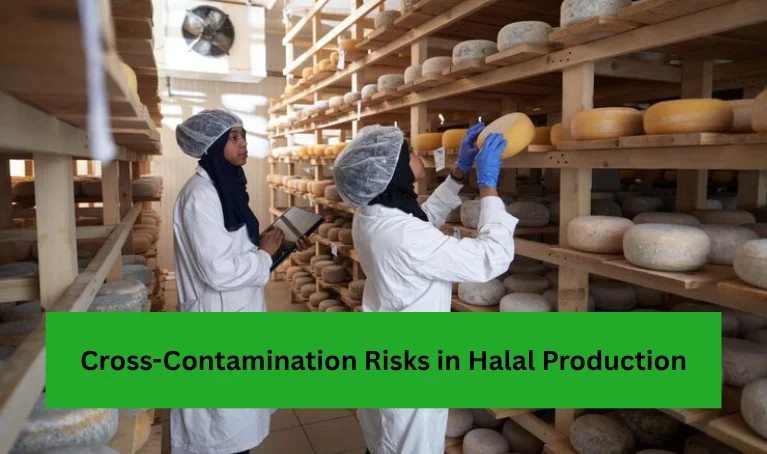
Cross-Contamination Risks in Halal Production

Cross-contamination in Halal production refers to the unintended contact of Halal products with Haram substances, ingredients, or processes that compromise their religious compliance. This risk is significant because Halal standards encompass not only permissible ingredients but also ethical handling, storage, and processing practices. Effective management of cross-contamination is essential for maintaining Shariah compliance, protecting consumer trust, and meeting regulatory requirements. This guide explores the risks, consequences, and mitigation strategies in a structured, practical manner for food producers and businesses.

Understanding Cross-Contamination in the Halal Context

Cross-contamination occurs when Halal food comes into contact with non-Halal ingredients, surfaces, equipment, or personnel, thereby compromising its permissibility. In a Halal context, this includes contamination from pork derivatives, non-Halal meat, alcohol, or any prohibited additives. The scope extends beyond ingredients to encompass processing lines, storage facilities, utensils, packaging, and transportation. Understanding the full range of contamination risks is critical for Halal compliance and is a core requirement for certification and audit readiness.

Helpful for you: Halal vs Halal-Friendly: What’s the Difference?

Cross-Contamination Risks in Halal Production

1. Shared Equipment and Utensils

Using the same cutting boards, knives, or mixers for Halal and non-Halal products can result in direct contamination. Even trace residues of Haram substances compromise the Halal status of products. Facilities must implement dedicated equipment or validated cleaning protocols. Documentation of cleaning procedures is essential to demonstrate compliance.

2. Inadequate Cleaning and Sanitation

Insufficient sanitation between production runs increases the likelihood of cross-contact. Harms can arise from residual fats, oils, flavorings, and food additives originating from non-Halal sources that remain on equipment or surfaces. Structured cleaning schedules, validated procedures, and routine inspections are necessary to maintain operational integrity and consistent compliance. Proper cleaning prevents contamination, ensures removal of prohibited substances including food additives, and supports overall food safety and quality standards.

3. Shared Storage Areas

Storing Halal and non-Halal ingredients or products in the same warehouse without segregation risks cross-contamination. Containers or pallets can transfer traces of Haram substances. Segregation by location, labeling, and physical barriers is essential. Temperature-controlled storage must also adhere to these separation protocols.

Also Read: How Restaurants Can Maintain Halal Compliance

4. Supplier and Ingredient Mislabeling

Receiving raw materials with unclear or incorrect labeling can introduce non-Halal ingredients into production lines. Suppliers must provide clear ingredient declarations and certifications. Verification procedures, including documentation review and periodic audits, help mitigate this risk. Traceability ensures Halal compliance from source to product.

5. Cross-Contamination During Transportation

Halal products transported in shared vehicles with non-Halal goods face a risk of contamination. Residual particles, spills, or improper cleaning can compromise Halal integrity. Using dedicated transport or validated cleaning procedures is critical. Proper documentation of transport compliance reinforces operational accountability.

6. Human Handling and Training Gaps

Employees unaware of Halal requirements may inadvertently contaminate products. Handling Halal and non-Halal items without proper training or PPE increases risks. Staff education programs, clear SOPs, and supervision ensure adherence to religious and operational standards. Human factors are often a leading source of contamination.

Must Read: Importance of Halal Training for Quality Personnel

7. Cross-Contact Through Additives or Flavorings

Non-Halal emulsifiers, stabilizers, or flavorings can contaminate Halal products if shared across production lines. Verification of each additive’s source and composition is essential. Certification of raw materials helps prevent accidental introduction of Haram substances. Maintaining supplier transparency is critical for compliance.

8. Inadequate Packaging Practices

Packaging Halal products in materials previously used for non-Halal items may transfer traces of contamination. Packaging lines must be segregated or thoroughly cleaned. Labeling must clearly indicate Halal compliance to prevent consumer confusion. Proper packaging safeguards both religious and quality standards.

9. Airborne or Environmental Contamination

Dust, vapors, or aerosolized particles from Haram products in shared production environments may contaminate Halal food. Proper ventilation, physical separation, and airflow management minimize this risk. Environmental monitoring ensures that cross-contamination does not occur indirectly.

10. Errors in Documentation and Traceability

Incomplete or inaccurate records of ingredients, processes, or handling can lead to unintentional Halal breaches. Traceability failures make it difficult to verify compliance during audits. Structured documentation, real-time monitoring, and periodic review are essential to prevent contamination and demonstrate accountability.

Consequences of Cross-Contamination

1. Loss of Halal Certification

Cross-contamination with Haram substances can lead to suspension or revocation of Halal certification, affecting product legitimacy and market access. Businesses may need to implement corrective actions before certification is reinstated, delaying operations.

2. Legal and Regulatory Non-Compliance

Contaminated Halal products may violate national food laws, leading to fines, penalties, or production restrictions. Export operations can also be impacted, as many countries require verified Halal compliance for imported products.

Must Read: Halal Certification Requirements for Food Products

3. Damage to Brand Reputation

Incidents of cross-contamination negatively affect consumer trust and brand perception. Reduced loyalty and public backlash may occur, and rebuilding credibility often requires significant time and resources.

4. Financial Losses from Recalls or Rejection

Contaminated products may need to be recalled or rejected by distributors, generating disposal, reprocessing, and logistical costs. Production downtime further increases financial impact and operational disruptions.

5. Compromise of Consumer Trust and Market Position

Cross-contamination undermines confidence among Muslim consumers and can reduce market share. Maintaining strict Halal compliance is essential for long-term customer loyalty and competitive positioning.

Strategies to Prevent Cross-Contamination

Effective prevention relies on a combination of operational, procedural, and technological measures. These include dedicated equipment, validated cleaning protocols, ingredient verification, physical segregation in storage and production, employee training, clear SOPs, environmental monitoring, transport segregation, and robust traceability systems. Integrating digital tools for monitoring and record-keeping can further enhance prevention and ensure consistent compliance with Halal standards.

You may also like: Emerging Technologies in Halal Certification

Role of Halal Certification in Mitigating Risks

Halal certification provides structured oversight to prevent cross-contamination. Certification bodies evaluate production processes, ingredient sourcing, handling procedures, sanitation practices, and documentation. Through audits and Shariah supervision, certification ensures that facilities maintain segregation, traceability, and operational controls. Certification also gives consumers and regulatory authorities confidence in the integrity of Halal products.

How NHASA Can Help You

NHASA offers comprehensive Halal certification for food manufacturers in Australia, along with advisory services designed to minimize cross-contamination risks and ensure full compliance. Our approach includes on-site audits, process evaluation, supplier verification, employee training programs, and implementation of validated cleaning protocols. We assist businesses in establishing robust Halal assurance systems that integrate seamlessly with existing quality and food safety frameworks. Partnering with NHASA ensures both regulatory compliance and strong consumer trust in your Halal-certified food products.

Conclusion

Cross-contamination is one of the most critical risks in Halal production, impacting religious compliance, operational integrity, and market trust. Understanding potential contamination sources, implementing preventive strategies, and obtaining formal Halal certification are essential for businesses. By maintaining structured controls, clear documentation, and rigorous supervision, producers can safeguard the Halal status of their products and strengthen consumer confidence.

FAQs

What is cross-contamination in Halal production?

Cross-contamination occurs when Halal products come into contact with Haram substances, ingredients, or processes, compromising religious compliance.

Can Halal products lose certification due to contamination?

Yes, even trace contamination from non-Halal sources can result in audit failure or certification suspension.

How can cross-contamination be prevented in shared facilities?

Segregation, validated cleaning protocols, staff training, and proper documentation are key preventive measures.

Does transport affect Halal compliance?

Yes, shared vehicles with non-Halal goods pose a risk unless properly cleaned and segregated.

How does Halal certification help mitigate risks?

Certification ensures structured oversight, process audits, ingredient verification, and supervisory compliance to prevent cross-contamination.